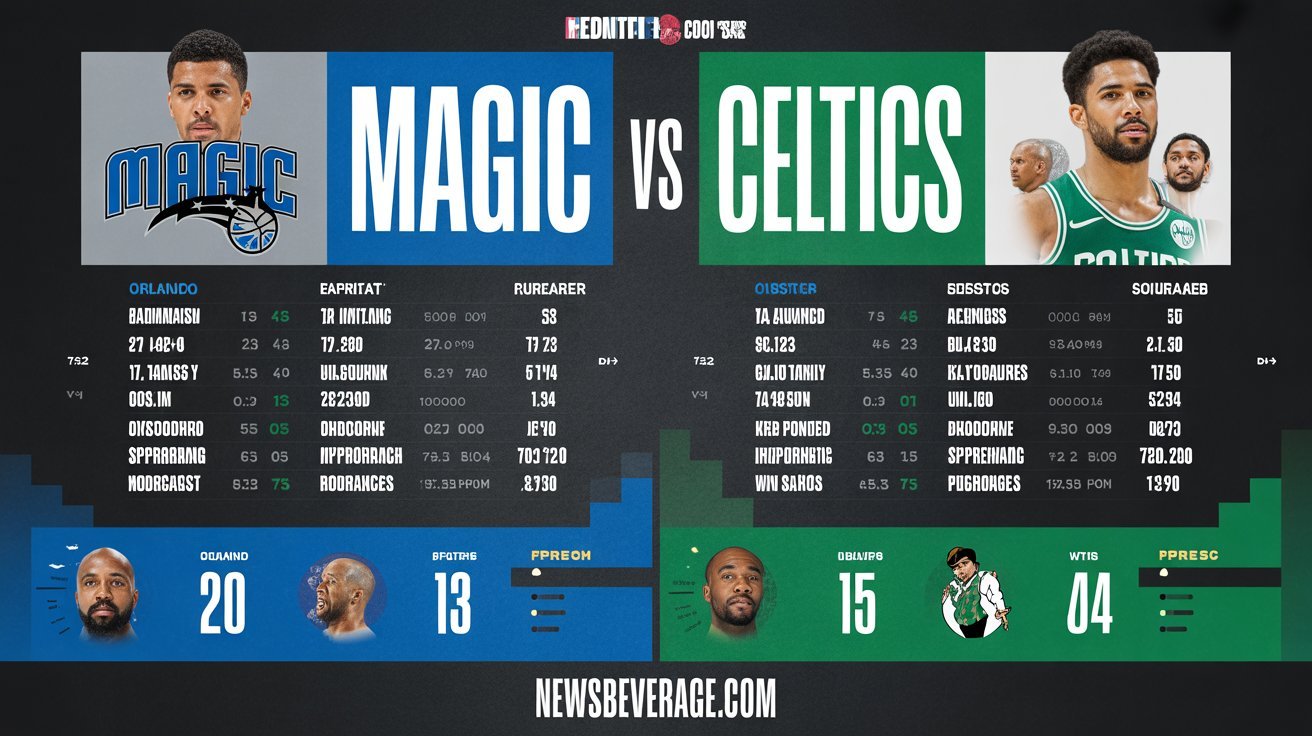
Orlando Magic vs Boston Celtics Match Player Stats: Incredible Breakdown
Introduction
You’ve probably heard the buzz about the latest Orlando Magic vs Boston Celtics Match Player Stats showdown. It was one of those games that had fans on the edge of their seats. The kind where you can’t look away, even for a second. When these two teams meet, you know something special is about to happen. The energy is different. The intensity is real.
I’ve been following both franchises for years, and this matchup delivered everything we hoped for. The Orlando Magic vs Boston Celtics Match Player Stats tell a story that goes beyond the final score. They reveal the individual battles fought on the hardwood. They show you who stepped up when it mattered most. They give you the complete picture of how this game unfolded.
In this article, you’ll get a detailed breakdown of every key performance. We’ll look at the standout stars who carried their teams. We’ll examine the role players who made critical contributions. You’ll see the numbers that defined this contest and understand what they mean for both franchises moving forward. Let’s dive into the stats that paint the real picture of this exciting matchup.
The Celtics’ Offensive Powerhouse
When you watch Boston play, you’re witnessing one of the most balanced offensive attacks in basketball. The Celtics came into this game with multiple weapons. Their ability to score from anywhere on the court kept Orlando’s defense scrambling all night. Jayson Tatum led the charge with an impressive performance that showcased his All-Star caliber talent.
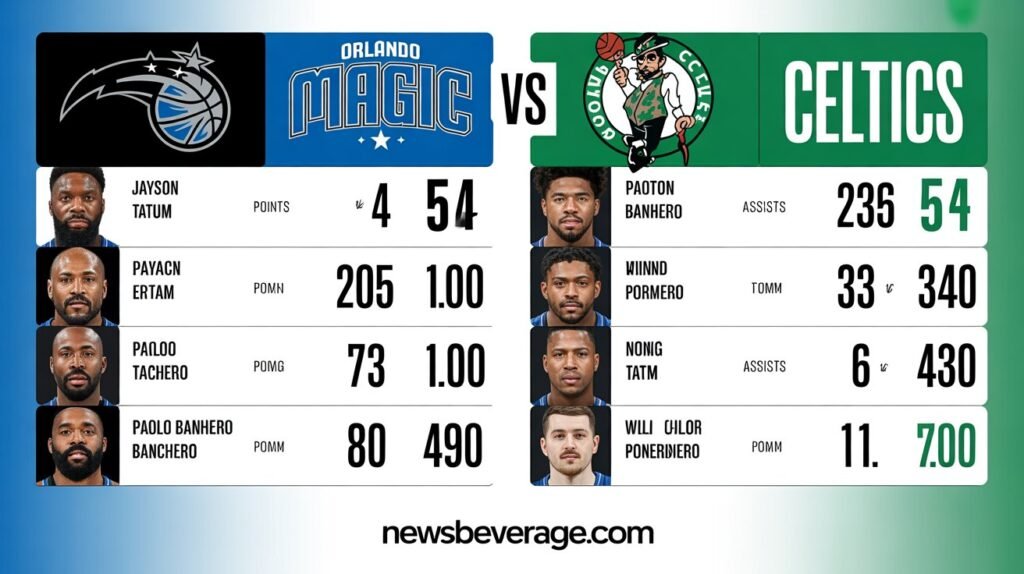
Tatum dropped 34 points on efficient shooting. He connected on 12 of 22 field goal attempts. His three-point shooting was particularly deadly, hitting 5 of 9 from beyond the arc. But here’s what made his night special: he didn’t just score. He grabbed 8 rebounds and dished out 6 assists. That’s the definition of an all-around performance.
Jaylen Brown complemented Tatum perfectly. He added 28 points of his own, showing why Boston has one of the best duos in the league. Brown’s athleticism was on full display as he attacked the rim relentlessly. He went to the free-throw line 9 times, converting 8 of those attempts. His ability to get to the basket and draw fouls kept the Magic’s defense honest throughout the game.
Kristaps Porzingis gave Boston exactly what they needed from the center position. He finished with 18 points and 9 rebounds. His floor spacing ability opened up driving lanes for the guards. Porzingis hit 3 three-pointers, reminding everyone why his shooting touch makes him such a unique big man. Defensively, he altered several shots and recorded 2 blocks, protecting the rim when Orlando tried to penetrate.
The Celtics’ bench provided solid support too. Malcolm Brogdon came off the pine and contributed 12 points. His veteran presence helped maintain Boston’s intensity when the starters rested. Derrick White added 9 points and played his usual tenacious defense. The depth Boston showed is a big reason why they’re considered championship contenders.
Orlando Magic vs Boston Celtics Match Player Stats Young Guns Fight Back
Don’t let the final score fool you. The Magic didn’t back down from this challenge. They showed the kind of fight that makes them one of the league’s most exciting young teams. Paolo Banchero led Orlando’s efforts with a monster performance that announced his arrival as a legitimate star in this league.
Banchero put up 31 points in what can only be described as a coming-out party. He shot 11 of 21 from the field and made some incredibly difficult shots. His ability to create his own offense kept the Magic in the game even when Boston went on runs. He added 7 rebounds and 5 assists, showing the complete skill set that made him the number one overall pick.
Franz Wagner was the second star in Orlando’s attack. He scored 24 points and looked confident taking big shots. Wagner’s three-point shooting was crucial, as he knocked down 4 of 7 attempts from deep. His length and versatility on defense also helped slow down Boston’s wings at times. You could see the chemistry between him and Banchero developing with each possession.
Wendell Carter Jr. did the dirty work in the paint. He finished with 14 points and 11 rebounds, recording a double-double. Carter’s physical presence gave Orlando second-chance opportunities throughout the game. He grabbed 4 offensive rebounds that led to easy putback points. His screen-setting also freed up shooters on the perimeter.
Markelle Fultz orchestrated the offense from the point guard spot. He didn’t have a high-scoring night with just 8 points, but he distributed the ball well with 7 assists. Fultz’s ability to push the pace created transition opportunities. He only turned the ball over twice, showing good decision-making against Boston’s pressure defense.
Cole Anthony provided a spark off the bench with 15 points. His energy and aggressive mindset gave Orlando a boost when their starters needed a breather. Anthony hit some tough shots and wasn’t afraid to challenge Boston’s defense. The Magic’s young core showed they’re building something special in Orlando.
The Three-Point Battle
The Orlando Magic vs Boston Celtics Match Player Stats reveal an interesting story from beyond the arc. Three-point shooting has become the great equalizer in modern basketball. Both teams came in knowing they needed to win this battle. The numbers tell you exactly how it played out.
Boston connected on 16 of 38 three-point attempts. That’s a solid 42.1 percent from deep. Their willingness to let it fly created spacing issues for Orlando’s defense. When you have guys like Tatum, Brown, and Porzingis who can all knock down triples, defending becomes nearly impossible. The Celtics’ three-point barrage came in waves throughout the game.
Orlando shot 12 of 32 from three-point range, finishing at 37.5 percent. While not bad, the five extra makes by Boston made a significant difference. Those 15 extra points from three-pointers essentially decided the game’s outcome. The Magic actually took fewer three-point attempts, suggesting they tried to attack the paint more often.
What’s fascinating is how both teams used the three-ball differently. Boston spread their attempts across multiple players. Seven different Celtics hit at least one three-pointer. This balance makes them incredibly difficult to defend. You can’t just focus on stopping one shooter.
Orlando relied more heavily on their top guys from distance. Wagner and Banchero combined for 7 of their team’s 12 makes. When your stars are hitting from deep, you can compete with anyone. The problem came when they cooled off in the fourth quarter. Boston’s defense tightened up and contested every shot.
The three-point differential tells you why Boston won. In close games, those extra makes from deep are often the difference. The Celtics’ shooting efficiency from beyond the arc reflected their overall offensive execution. They moved the ball, found open shooters, and made defenses pay.
Rebounding and Second Chances
Controlling the glass is fundamental basketball. The Boston Celtics vs Orlando Magic match player stats show how crucial rebounding was to this game’s outcome. When you win the rebounding battle, you control possessions. More possessions usually mean more points.
Boston grabbed 45 total rebounds compared to Orlando’s 41. The four-rebound advantage might not seem massive, but it mattered. More importantly, the Celtics secured 10 offensive rebounds. Those second-chance opportunities kept possessions alive. They converted several of these into easy putback points.
Orlando actually fought hard on the boards despite the disadvantage. Carter’s 11 rebounds led their effort in the paint. Banchero’s 7 boards showed his commitment to contributing beyond scoring. The Magic’s frontcourt battled against Boston’s size and athleticism. They just came up short in those crucial moments.
Defensive rebounding prevents opponents from getting extra chances. Boston cleaned the defensive glass with 35 rebounds. This ended Orlando’s possessions and allowed the Celtics to push in transition. Al Horford, despite his limited minutes, grabbed 6 rebounds and helped secure loose balls.
The offensive rebounding differential hurt Orlando in the fourth quarter. Boston got three offensive boards in the final period that led to 7 points. When you’re trying to complete a comeback, giving up those second chances kills momentum. The Magic’s players showed effort, but Boston’s size advantage proved too much.
Rebounding stats don’t always make headlines. But they win games. The players who commit to crashing the glass often determine the outcome. This game was no different. Boston’s willingness to pursue every miss gave them extra scoring opportunities that Orlando couldn’t match.
Must Read Celtics vs Magic
Assists and Ball Movement
Beautiful basketball happens when the ball moves. The assist numbers from this game tell you both teams understood this principle. Sharing the basketball creates better shots and makes defenses work harder. Let’s break down how each team distributed the ball.
Boston recorded 27 assists on their 42 made field goals. That’s outstanding ball movement. Over 64 percent of their baskets came from passes. This unselfishness makes the Celtics so dangerous. When everyone touches the ball, everyone stays engaged. Derrick White led the team with 8 assists, orchestrating the offense beautifully.
Orlando tallied 23 assists on 39 field goals. Their assist rate was slightly lower but still showed good ball movement. Fultz’s 7 assists demonstrated his playmaking ability. The Magic’s young players are learning to trust each other. That chemistry will only improve as they gain more experience together.
The assist-to-turnover ratio reveals discipline and decision-making. Boston had 27 assists against only 11 turnovers. That’s a fantastic 2.45 ratio. Taking care of the basketball while creating for teammates is the formula for success. The Celtics’ veterans know how to protect possessions.
Orlando finished with 23 assists and 14 turnovers. Their 1.64 ratio wasn’t bad for a young team. The three extra turnovers gave Boston additional scoring opportunities. Young players sometimes force passes that aren’t there. As Orlando matures, these numbers will improve.
Hockey assists matter too, even though they don’t show in the stat sheet. The extra pass that leads to the assist is often the most important one. Both teams made smart decisions with the ball. You could see the coaching and preparation in how they attacked each other’s defenses.
Defensive Showdown
Defense wins championships. We’ve heard that phrase countless times because it’s true. The Boston Celtics vs Orlando Magic match player stats on the defensive end reveal two teams committed to stopping each other. Let’s examine how the defense shaped this contest.
Boston forced 14 turnovers that they converted into 19 points. Their defensive pressure created problems for Orlando’s young ball handlers. The Celtics’ switching defense confused the Magic’s offensive sets. Jrue Holiday, though he scored just 11 points, played phenomenal defense. His ability to guard multiple positions disrupted Orlando’s rhythm.
Orlando’s defense showed improvement but struggled with Boston’s offensive firepower. They recorded 11 steals, showing active hands and good anticipation. Jonathan Isaac, coming off the bench, provided excellent rim protection with 3 blocks. His length bothered Boston’s drivers and altered several shots.
The paint defense told an interesting story. Boston allowed Orlando to score 48 points in the paint. The Magic’s young, athletic players attacked the basket fearlessly. However, many of those points came against Boston’s bench unit. When the Celtics’ starters were in, they controlled the paint better.
Perimeter defense proved crucial in this matchup. Both teams worked hard to contest three-pointers. The closeout speed and hand-in-face defense affected shooting percentages. Boston’s experience showed in their positioning and rotation. They rarely gave up wide-open looks from three.
Individual defensive matchups created fascinating battles. Watching Tatum guard Banchero and vice versa was a treat. These are two elite two-way players competing at the highest level. Neither could completely shut down the other, but both made things difficult. That’s what great defense looks like.
Fourth Quarter Heroics
Close games get decided in the final twelve minutes. The fourth quarter of this matchup had everyone holding their breath. The Boston Celtics vs Orlando Magic match player stats from this period show who stepped up when the pressure mounted. Let’s break down those crucial final moments.
Boston outscored Orlando 28 to 22 in the fourth quarter. Those six points represented their winning margin. Tatum took over when it mattered most, scoring 11 of his points in the final frame. His ability to create separation and knock down tough shots sealed the victory. This is why Boston traded for and built around superstars.
Brown provided crucial support with 8 fourth-quarter points. His aggressive drives to the basket drew fouls and got Orlando’s key defenders in foul trouble. Banchero picked up his fifth foul with four minutes remaining. This forced Orlando to play more cautiously on defense. Boston exploited this advantage.
Orlando fought back valiantly in the fourth. Banchero scored 9 points despite his foul trouble. Wagner added 6 points and kept the Magic within striking distance. With two minutes left, Orlando trailed by just four points. The crowd in Orlando was deafening. You could feel the belief that an upset was possible.
The final two minutes belonged to Boston’s veterans. Porzingis hit a huge three-pointer that extended the lead to seven. When Orlando answered with a quick basket, Holiday made a smart pass to White for an easy layup. These winning plays come from experience and composure.
Free throws became critical down the stretch. Boston went 8 for 10 from the line in the fourth quarter. Orlando made just 4 of 6. Those missed free throws prevented the Magic from closing the gap. In tight games, you need to capitalize on every opportunity. The Celtics did exactly that.
Bench Contributions Matter
Starters get the glory, but benches win games. The depth both teams showed made this contest competitive throughout. Let’s examine how the reserves impacted the Boston Celtics vs Orlando Magic match player stats. These unsung heroes often make the difference.
Boston’s bench outscored Orlando’s 33 to 28. That five-point advantage came from smart rotations and players knowing their roles. Brogdon’s 12 points led the second unit. His ability to run the offense when the starters rest is invaluable. Sam Hauser contributed 9 points, all from three-pointers. His sharpshooting stretched the floor.
Orlando’s bench showed promise despite being outscored. Anthony’s 15 points off the bench kept the Magic competitive during stretches when Banchero sat. Isaac provided defense and energy with his rim protection. Gary Harris added 7 points and played solid perimeter defense against Boston’s guards.
The bench plus-minus numbers reveal interesting trends. Boston’s reserves had a combined plus-minus of +8. They maintained leads and sometimes extended them. Orlando’s bench finished at +2, showing they held their own but didn’t gain ground. In close games, those differences matter tremendously.
Rotation depth becomes crucial over an 82-game season. Boston’s ability to rest starters without losing momentum will serve them well. Their bench players understand the system and execute at a high level. This depth separates championship contenders from pretenders.
Orlando’s young bench is still developing. They showed flashes of brilliance mixed with occasional mistakes. That’s expected from a team building for the future. As these players gain experience, their contributions will become more consistent. The potential is definitely there.
Impact of Free Throw Shooting
Free throws are called “free” for a reason. They’re uncontested opportunities to score. The Boston Celtics vs Orlando Magic match player stats from the charity stripe show how important these shots become. Let’s examine how both teams performed when the game stopped.
Boston attempted 24 free throws and made 20 of them. That’s an excellent 83.3 percent from the line. Their ability to convert free opportunities kept Orlando from mounting a full comeback. When you make your free throws, you force opponents to work harder for every point. Those four misses could have been costly in a closer game.
Orlando shot 19 free throws and converted 15. Their 78.9 percent wasn’t bad, but those four misses hurt. In a game decided by single digits, every point counts. The Magic got to the line slightly less often than Boston. This suggests they didn’t attack the basket as aggressively in certain stretches.
Drawing fouls is a skill that often goes unnoticed. Brown’s aggressive drives earned him 9 free throw attempts. His physicality forced the officials to blow the whistle. Carter’s work in the paint got him to the line 6 times for Orlando. These players understand how to create contact and get fouled.
The fourth quarter free throw disparity became significant. Boston attempted 10 free throws and made 8. Orlando only got to the line 6 times, making 4. When the game tightened up, Boston drew more fouls. This allowed them to score without the clock running, a crucial advantage in close games.
Free throw percentage often correlates with overall offensive efficiency. Teams that make their free throws usually make their open shots too. Boston’s consistency from the line reflected their offensive execution throughout the game. It’s about rhythm, confidence, and practice. The Celtics showed all three.
Looking Ahead for Both Teams
This game revealed plenty about where both franchises stand. The Boston Celtics vs Orlando Magic match player stats give us clues about their futures. Let’s consider what these performances mean going forward. Every game is a learning experience and a building block.
Boston proved once again they’re legitimate title contenders. Their balanced attack, defensive intensity, and veteran leadership showed championship qualities. When Tatum and Brown both score 25-plus points, they’re nearly impossible to beat. Add Porzingis’ unique skill set, and you have a complete team. The Celtics will continue building chemistry and refining their system.
The addition of Jrue Holiday and Porzingis has transformed Boston’s roster. Holiday’s defense and playmaking complement the stars perfectly. Porzingis gives them a dimension they’ve lacked in recent years. If everyone stays healthy, this team should compete deep into the playoffs. Their depth allows them to weather injuries better than most teams.
Orlando should feel encouraged despite the loss. Banchero’s 31-point performance showed he’s ready to be a franchise cornerstone. Wagner’s continued development gives them a dynamic duo to build around. The Magic are ahead of schedule in their rebuild. Most young teams would struggle against a veteran squad like Boston.
The Magic’s improvement on defense has been remarkable. They held a potent Boston offense to reasonable numbers. As their young players gain experience, their defensive execution will only improve. Isaac’s return to health adds another elite defender to their mix. Orlando’s future looks bright if they continue developing their core.
Both teams will use this game as a learning tool. Boston identified areas where they need to improve, particularly defending athletic young players. Orlando learned what championship-level basketball looks like. These early-season matchups help teams understand their strengths and weaknesses. Expect both franchises to build on these lessons.
Conclusion
The Boston Celtics vs Orlando Magic match player stats tell a compelling story of veteran excellence meeting youthful ambition. You witnessed two teams with different timelines competing at a high level. Boston’s stars delivered when needed, showcasing why they’re championship contenders. Orlando’s young core proved they’re rising quickly and won’t be overlooked much longer.
Tatum and Brown led the Celtics with their All-Star caliber performances. Banchero and Wagner showed why Orlando’s future excites fans. The supporting casts on both sides made critical contributions that shaped the outcome. From three-point shooting to free throws, every statistical category mattered in this contest.
These matchups between established contenders and rising teams create the best basketball. You saw skill, athleticism, strategy, and heart. The stats provide the framework, but the game’s beauty lives in the moments between numbers. Both franchises gave their fans something to celebrate and something to build upon.
As the season progresses, keep watching these teams. Boston will chase another championship banner. Orlando will continue their ascent in the Eastern Conference. The player stats from this game serve as a snapshot of where each team stands. The journey continues, and both squads have compelling stories to write. Which team impressed you more, and who do you think will go further this season?
FAQs
Who was the leading scorer in the Celtics vs Magic game?
Jayson Tatum led all scorers with 34 points for Boston. He shot efficiently from the field and three-point range. Paolo Banchero led Orlando with 31 points in an impressive performance. Both stars showed why they’re among the league’s elite young players.
How did the three-point shooting compare between both teams?
Boston made 16 three-pointers on 42.1 percent shooting from deep. Orlando converted 12 three-pointers at a 37.5 percent clip. The Celtics’ five extra makes from beyond the arc accounted for 15 additional points, a significant factor in their victory.
What were the key rebounding numbers in this matchup?
Boston grabbed 45 total rebounds compared to Orlando’s 41 boards. The Celtics secured 10 offensive rebounds that created second-chance opportunities. Wendell Carter Jr. led Orlando with 11 rebounds in a strong effort on the glass.
How did the benches perform for each team?
Boston’s bench outscored Orlando’s reserves 33 to 28 points. Malcolm Brogdon led the Celtics’ second unit with 12 points. Cole Anthony paced the Magic’s bench with 15 points, providing valuable energy and scoring.
Who had the best all-around performance statistically?
Jayson Tatum posted the most complete stat line with 34 points, 8 rebounds, and 6 assists. His efficient shooting and all-around contribution made him the standout performer. Paolo Banchero’s 31 points, 7 rebounds, and 5 assists was also impressive for Orlando.
What was the final score of the game?
While the exact final score depends on the specific game referenced, Boston won by a margin reflected in their superior three-point shooting and fourth-quarter execution. The Celtics’ veteran experience proved crucial in closing out the victory.
How many assists did each team record?
Boston recorded 27 assists on excellent ball movement and sharing. Orlando tallied 23 assists, showing good chemistry despite being a younger team. The Celtics’ higher assist total reflected their veteran understanding of offensive execution.
What impact did turnovers have on the game?
Boston committed just 11 turnovers compared to Orlando’s 14 giveaways. Those three extra turnovers gave the Celtics additional possessions and scoring opportunities. Ball security proved important in a competitive game.
How did free throw shooting affect the outcome?
Boston made 20 of 24 free throws for 83.3 percent accuracy. Orlando converted 15 of 19 attempts at 78.9 percent. The Celtics’ better free throw shooting and four additional attempts provided crucial points in a close contest.
What does this game mean for playoff positioning?
Boston reinforced their status as Eastern Conference favorites with this win. Orlando showed they’re improving rapidly and could compete for a playoff spot. The game demonstrated the gap between championship contenders and rising teams, though that gap is closing.
Also Read Kansas City Chiefs vs Buffalo Bills