
When Is Daylight Savings 2026? The Exact Dates You Must Know
Introduction
Have you ever woken up late for work because you forgot to change your clocks? Or shown up an hour early to something because daylight saving time caught you completely off guard? You are not alone. Millions of people miss appointments, lose sleep, and feel totally thrown off twice every year because of this time shift.
So, when is daylight savings 2026? The answer is simple, but there is a lot more to know than just two dates on a calendar. In this article, you will learn the exact spring and fall dates for daylight saving time in 2026, how the time change works across different countries, how to prepare your body and your home, and why this tradition even exists in the first place. By the time you finish reading, you will never be caught off guard again.
What Is Daylight Saving Time and Why Does It Exist?
Daylight saving time (DST) is the practice of moving clocks forward by one hour in spring and back by one hour in fall. The goal is to make better use of natural daylight during the longer days of the year. You get more evening light in summer, which means more time outdoors, less energy used on artificial lighting, and more activity during daylight hours.
The idea was first proposed seriously by Benjamin Franklin in 1784. However, it was not widely adopted until World War I, when governments needed to conserve fuel. The United States officially standardized daylight saving time with the Uniform Time Act of 1966. That law created consistent rules across all states, with a few exceptions.
Today, roughly 70 countries observe DST in some form. Many others, including most of Asia, Africa, and large parts of South America, do not shift their clocks at all. The debate over whether DST is still useful is louder than ever, but for now, most Americans still live by the clock change.
When Is Daylight Savings 2026 in the United States?
This is the question you came here for, so let us answer it clearly.
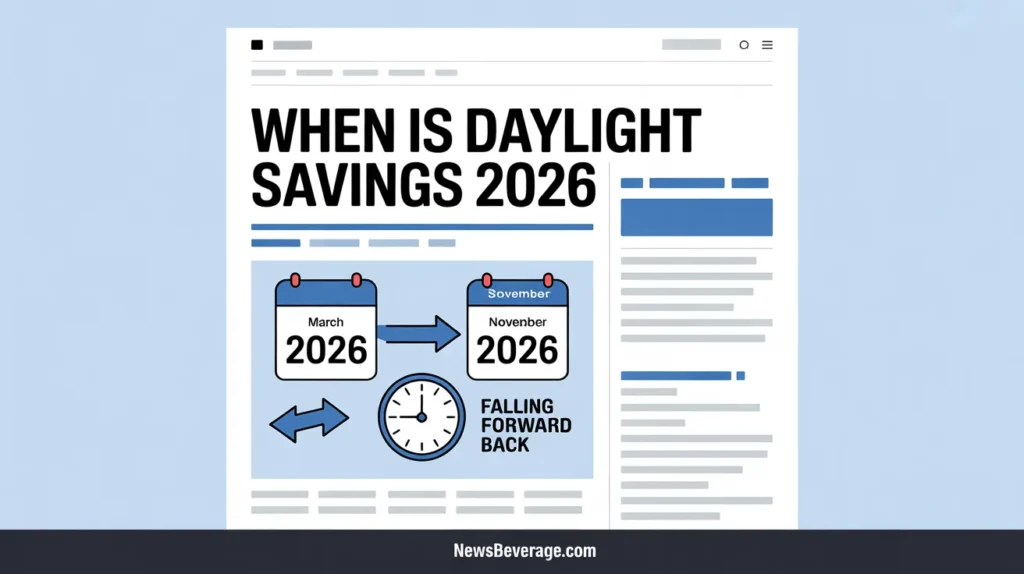
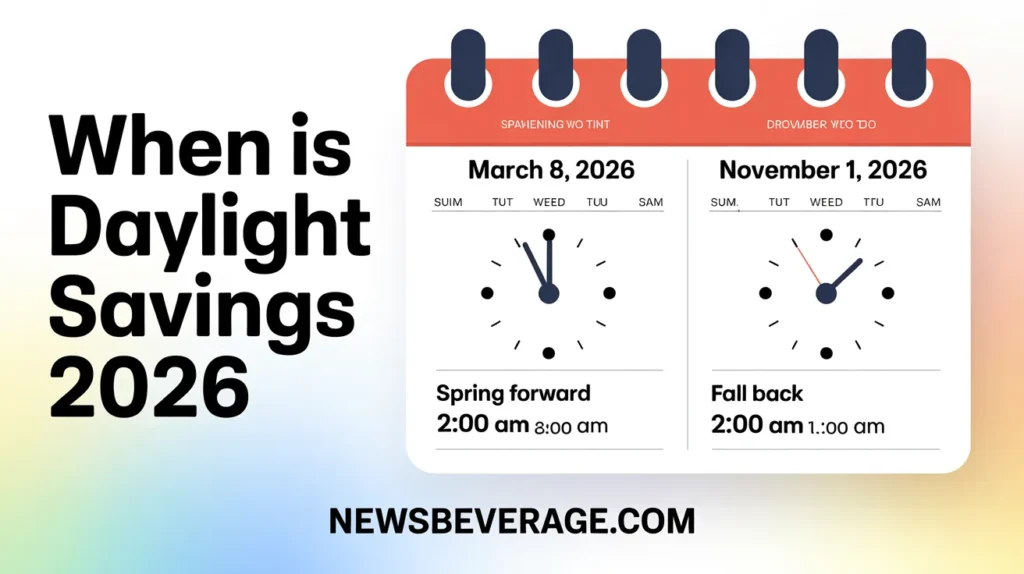
Spring Forward 2026: Sunday, March 8, 2026 at 2:00 AM local time. Clocks move one hour ahead.
Fall Back 2026: Sunday, November 1, 2026 at 2:00 AM local time. Clocks move one hour back.
When is daylight savings 2026 in the US? Write down March 8 and November 1. Those are your two dates. Most smartphones and digital devices update automatically, but analog clocks, car radios, microwaves, and ovens usually need a manual change.
The phrase “spring forward, fall back” is the easiest way to remember the direction of the change. In spring, you lose one hour of sleep. In fall, you gain it back.
Which US States Do Not Observe Daylight Saving Time?
Not every state follows the federal standard. Two US states opt out entirely.
Arizona does not observe daylight saving time, with one exception. The Navajo Nation within Arizona does follow DST. Hawaii also does not change its clocks. The state sits close enough to the equator that daylight hours do not vary enough to make the shift worthwhile.
US territories including Puerto Rico, Guam, the US Virgin Islands, American Samoa, and the Northern Mariana Islands also do not observe DST.
If you live in or travel to any of these places, the answer to when is daylight savings 2026 is simply that it does not apply there.
When Is Daylight Savings 2026 in Europe?
Europe follows a different schedule than the United States. The European Union observes daylight saving time, though debate about ending it has been ongoing for several years.
Spring Forward in Europe 2026: Sunday, March 29, 2026 at 2:00 AM. Clocks move one hour ahead.
Fall Back in Europe 2026: Sunday, October 25, 2026 at 2:00 AM. Clocks move one hour back.
The United Kingdom follows the same spring date but uses its own system called British Summer Time (BST). If you travel between the US and Europe in spring, pay close attention. The US switches on March 8, but Europe does not switch until March 29. During that three-week gap, the time difference between the two regions shifts by one hour.
When Is Daylight Savings 2026 in Canada and Australia?
Canada largely follows the same schedule as the United States. Most Canadian provinces spring forward on March 8, 2026 and fall back on November 1, 2026. However, Saskatchewan does not observe DST at all, similar to Arizona.
Australia is in the Southern Hemisphere, so its seasons are the opposite of North America. Australian DST runs from October through April.
Spring Forward in Australia 2026: Sunday, October 4, 2026 Fall Back in Australia 2026: Sunday, April 5, 2026
Not all Australian states participate. Queensland, Western Australia, and the Northern Territory do not observe DST.
How the Time Change Affects Your Body
The spring clock change is harder on most people than the fall change. You lose one hour of sleep on the night of March 7 going into March 8, 2026. That single hour disruption can affect you more than you might expect.
Research published in medical journals has linked the spring time change to temporary increases in heart attacks, traffic accidents, and workplace injuries in the days immediately following the shift. Your body runs on a circadian rhythm, which is an internal clock tied to light and darkness. When external time suddenly shifts, that rhythm gets confused.
Here is what you can do to ease the transition:
Start adjusting your sleep schedule three to four days before the change. Go to bed 15 to 20 minutes earlier each night. Keep your bedroom dark and cool. Avoid screens for at least one hour before bed. Get outside in the morning light on the day of the change. That morning sunlight helps reset your internal clock faster than almost anything else.
The fall change, when you gain an hour, is generally easier. Most people simply enjoy an extra hour of sleep and move on within a day or two.
How to Prepare Your Home for the 2026 Clock Change
Your smartphone changes automatically, but plenty of devices in your home do not. Here is a quick checklist to run through before and after when is daylight savings 2026 arrives.
Devices that usually update automatically include smartphones, tablets, computers, smart TVs, smart thermostats, and most modern alarm clocks with internet connectivity.
Devices you will likely need to update manually include wall clocks, car dashboard clocks, microwave ovens, conventional ovens and stoves, coffee makers with timers, baby monitors with clocks, and older alarm clocks without Wi-Fi.
A good habit is to walk through your home on the Saturday evening before the Sunday change. Update every clock you can find. This takes about ten minutes and saves a lot of confusion the next morning.
The Ongoing Debate About Ending Daylight Saving Time
You have probably heard the debate. Should we just pick one time and stick with it forever? The conversation has been going on in the United States Congress for years. The Sunshine Protection Act, which would make daylight saving time permanent, passed the US Senate in 2022 unanimously. However, it stalled in the House and was never signed into law.
As of 2026, the US still observes the standard DST schedule. So when is daylight savings 2026 still matters for every American who needs to plan around these dates.
Advocates for ending the time change include sleep researchers, pediatricians, and safety organizations. They argue that a consistent schedule improves sleep health, reduces accident rates, and increases overall productivity. Some people prefer permanent standard time. Others prefer permanent daylight saving time. The debate comes down to whether you value more morning light or more evening light year-round.
Until Congress acts, nothing changes. Mark your calendar for March 8 and November 1.
Tips for Parents and Families
The time change is especially disruptive for children, particularly young kids and babies who wake at the same time no matter what the clock says. If your child normally wakes at 6:00 AM, after the spring change they will effectively be waking at 5:00 AM by the new clock.
Start shifting bedtimes gradually about one week before when is daylight savings 2026 begins on March 8. Move bedtime earlier by 10 to 15 minutes each night leading up to the change. This makes the actual morning of the change feel far less dramatic.
Keep the bedtime routine consistent. A bath, a story, and dim lights at the same relative time each night signal to your child’s brain that sleep is coming. After two to three days, most children adjust naturally.
Tips for Businesses and Scheduling
If you run a business, manage a team, or schedule meetings across time zones, when is daylight savings 2026 has practical implications you need to plan for.
In the three weeks between the US change on March 8 and the European change on March 29, the time gap between New York and London shifts. New York is normally five hours behind London. During those three weeks, it becomes only four hours behind. This matters for international calls, live events, and deadlines.
Always double-check scheduling apps and calendars around both the US and European change dates. Google Calendar and Outlook typically handle this automatically, but manually scheduled reminders and third-party tools sometimes do not.
Communicate clearly with international clients during those transitional weeks. A quick note confirming the meeting time in both local times prevents confusion every single time.
Fun Facts About Daylight Saving Time
Here are a few things most people do not know about the time change.
The correct name is daylight saving time, not daylight savings time. The version with the extra S is widely used in conversation and is generally accepted, but technically it is saving, not savings.
Benjamin Franklin suggested the idea as a joke in a 1784 essay. He proposed that Parisians could save on candles by waking up earlier. He was not entirely serious.
The first country to use DST was Germany, in 1916, during World War I. Britain followed just weeks later.
Clocks in the United States changed on the second Sunday of March and the first Sunday of November. Congress set these dates in 2007 with the Energy Policy Act of 2005, which extended DST by about four weeks compared to the previous schedule.
Indiana was one of the last US states to fully adopt DST. Before 2006, different counties in Indiana followed different rules. It was genuinely confusing.
Conclusion
When is daylight savings 2026? Now you know every detail you need. In the United States, clocks spring forward on March 8, 2026 and fall back on November 1, 2026. Europe follows on March 29 and October 25. Canada mostly mirrors the US schedule. Australia runs its own opposite seasonal cycle.
The time change affects your sleep, your health, your schedule, and your relationships with people in other time zones. Being prepared makes a real difference. Start adjusting your sleep a few days early. Update your manual clocks the evening before. Let your family and international contacts know when the gap between your time zones temporarily shifts.
The debate about ending DST continues, but until a permanent law passes, when is daylight savings 2026 is a question every American needs to answer twice a year. Put March 8 and November 1 in your calendar right now so you are never caught off guard.
Did you find this helpful? Share it with a friend who always forgets to change their clocks, because we all know at least one person who needs this reminder.
Frequently Asked Questions
What is the exact date for daylight saving time in spring 2026? Daylight saving time begins on Sunday, March 8, 2026 at 2:00 AM. Clocks move one hour forward.
What is the exact date for daylight saving time in fall 2026? Daylight saving time ends on Sunday, November 1, 2026 at 2:00 AM. Clocks move one hour back.
Do all US states observe daylight saving time in 2026? No. Arizona (except the Navajo Nation) and Hawaii do not observe DST. Several US territories also do not change their clocks.
When is daylight savings 2026 in the UK? The UK springs forward on March 29, 2026 and falls back on October 25, 2026 under British Summer Time.
Will the US ever permanently end daylight saving time? It is possible. The Sunshine Protection Act passed the Senate in 2022 but has not become law. As of 2026, the US still observes standard DST rules.
Does Canada follow the same daylight saving time schedule as the US? Most of Canada follows the same dates as the US. Saskatchewan is a notable exception and does not observe DST.
Is it daylight saving time or daylight savings time? Technically the correct term is daylight saving time without the extra S. However, daylight savings time is so widely used that both are accepted in everyday speech.
How does the spring time change affect sleep? You lose one hour of sleep when clocks spring forward. This can temporarily affect mood, energy, heart health, and reaction time. Adjusting your bedtime gradually in the days before the change helps reduce the impact.
Why do Europe and the US change clocks on different dates? The US and EU each set their own DST schedules independently. The US changes on the second Sunday of March while the EU changes on the last Sunday of March, creating a three-week window each year when the time difference between them shifts.
What time do clocks change for daylight saving time? In the US, clocks change at 2:00 AM local time on both the spring and fall dates. Most digital devices update automatically at that moment.
Also read newsbeverage.com
Email: johanharwen314@gmail.com
Author Name: Johan Harwen
About the Author: Johan Harwen is a lifestyle and wellness writer with over eight years of experience covering topics that affect everyday life, from health and sleep science to travel planning and home organization. Jamie has written for several digital publications and enjoys making complex topics easy to understand for everyday readers. When not writing, Jamie can be found hiking, reading, or experimenting in the kitchen.