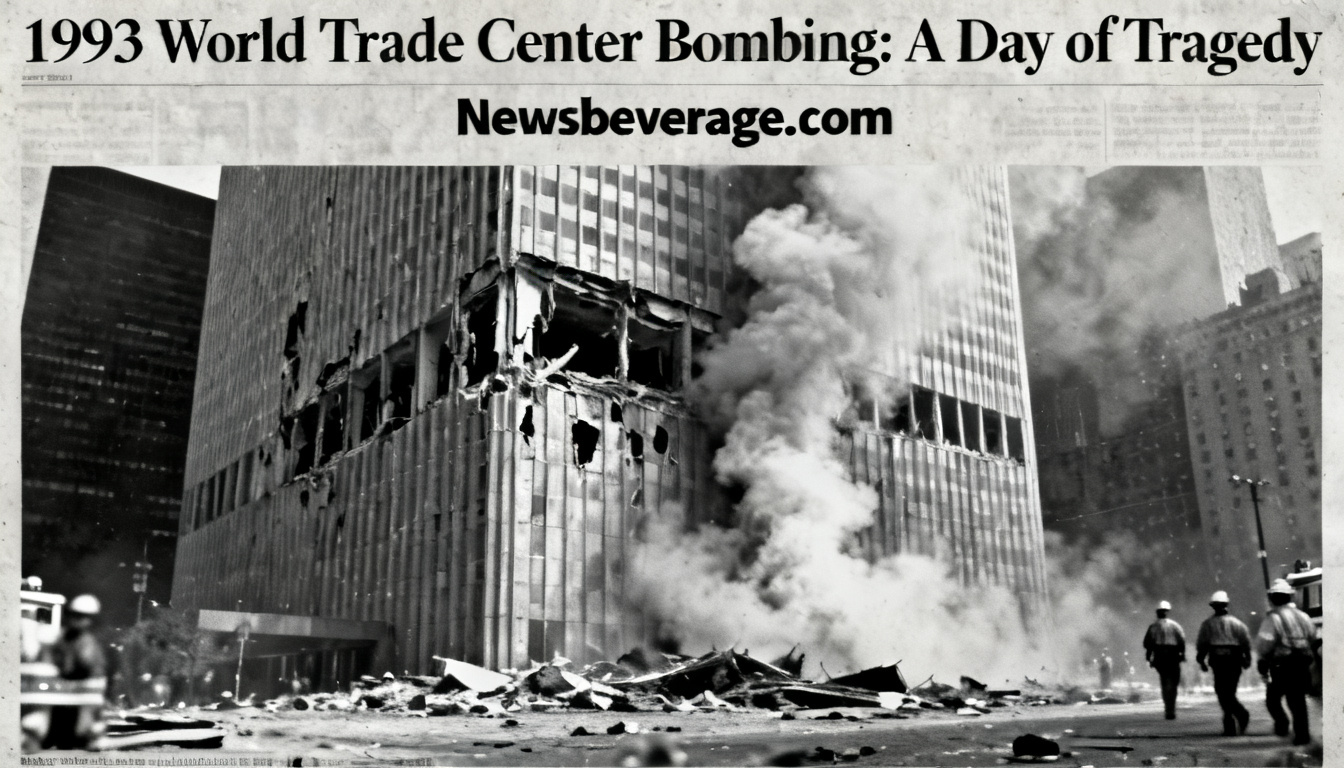
1993 World Trade Center Bombing: The Deadly Attack America Never Saw Coming
Introduction
On a cold February morning in 1993, a massive explosion tore through the underground parking garage of the World Trade Center in New York City. The blast rocked the towers, sent shockwaves through the streets, and killed six people instantly. Thousands more ran, screamed, and scrambled to escape smoke-filled stairwells.
You may know the World Trade Center from September 11, 2001. But the 1993 World Trade Center bombing was the first major foreign terrorist attack on American soil. It was a warning the country heard — but did not fully heed.

In this article, you will learn exactly what happened that day, who was behind it, how the investigation unfolded, and what changed because of it. Whether you are a history student, a researcher, or someone who simply wants to understand one of America’s most important turning points, this guide covers it all clearly and completely.
What Was the 1993 World Trade Center Bombing?
The 1993 World Trade Center bombing took place on February 26, 1993, at 12:17 PM. Terrorists detonated a truck bomb in the B-2 level of the underground parking garage beneath the North Tower of the World Trade Center in Lower Manhattan.
The bomb weighed approximately 1,336 pounds (606 kilograms). The blast created a 100-foot wide hole through several floors of concrete. It sent shockwaves upward through the tower and outward into neighboring structures.
Here are the key facts at a glance:
- Date: February 26, 1993
- Location: World Trade Center, North Tower parking garage, New York City
- Deaths: 6 people killed
- Injuries: Over 1,000 people injured
- Bomb Weight: Approximately 1,336 pounds
- Evacuation: Over 50,000 people evacuated from the towers
The goal of the attackers was catastrophic. They intended to topple the North Tower into the South Tower and kill tens of thousands of people. Fortunately, that plan failed. The towers stood. But the attack left a permanent scar on American history.
Who Were the Perpetrators?
The Mastermind: Ramzi Yousef
The primary architect of the 1993 World Trade Center bombing was Ramzi Yousef, a Pakistani-born militant with links to the emerging al-Qaeda network. Yousef entered the United States in September 1992 using an Iraqi passport. He was clever, technically skilled, and deeply motivated.
Yousef mixed the bomb components himself. He led the operational planning and helped secure financing for the attack. After the explosion, he fled to Pakistan just hours later.
Authorities eventually caught him in Islamabad in 1995 during an unrelated investigation into a plot called Operation Bojinka — a plan to blow up twelve American airliners simultaneously. He was extradited to the United States and convicted in 1997. He is currently serving a life sentence in a federal supermax prison.
The Co-conspirators
Yousef did not act alone. A larger group of individuals played key roles:
- Mohammed Salameh rented the Ryder van used to carry the bomb. He was arrested when he attempted to reclaim the rental deposit after the explosion — a mistake that unraveled the entire conspiracy.
- Nidal Ayyad was a chemical engineer who helped acquire and mix the bomb components. He also sent letters to newspapers claiming responsibility.
- Mahmud Abouhalima provided logistical support and was connected to Omar Abdel Rahman.
- Ahmad Ajaj traveled to Pakistan with Yousef and carried bomb-making manuals.
- Eyad Ismoil drove the bomb-laden truck into the parking garage.
The Blind Sheikh: Omar Abdel Rahman
Omar Abdel Rahman, an Egyptian cleric known as “The Blind Sheikh,” was tried and convicted in connection with the bombing as part of a broader seditious conspiracy. He ran a network of extremist followers operating out of mosques in New Jersey and New York.
Abdel Rahman never directly built the bomb. However, he provided religious legitimacy and ideological inspiration for the attack. He died in federal custody in 2017.
How Was the Bomb Built?
You might wonder how a group of men without military backing managed to construct such a powerful device. The answer is both alarming and instructive.
Yousef used a urea nitrate bomb — a type of fertilizer-based explosive — mixed with nitroglycerin, hydrogen gas cylinders, and aluminum azide. He acquired the materials legally from chemical suppliers across the United States.
The bomb was assembled in a storage unit in Jersey City, New Jersey. The conspirators loaded it into a Ryder rental van and drove it into the parking garage below the North Tower.
The fact that this bomb was built cheaply and legally with off-the-shelf materials was a wake-up call for American counterterrorism officials. Prior to 1993, few believed a foreign terrorist group could launch such an attack inside the United States.
The Day of the Attack: What Happened?
The Explosion
At 12:17 PM on February 26, 1993, the bomb detonated. The blast punched a crater roughly five stories deep and 100 feet wide through the concrete floors of the parking garage.
The explosion:
- Cut power to both towers immediately
- Disabled the emergency generators
- Knocked out most of the building’s communication systems
- Filled stairwells and elevator shafts with thick, black smoke
The Evacuation
The evacuation that followed was chaotic and dangerous. Over 50,000 workers and visitors were in the towers and the surrounding complex at the time of the explosion.
Many people were trapped in elevators. Others groped through pitch-black stairwells with no lighting. Children from a daycare center on the 107th floor were stranded for hours before firefighters reached them.
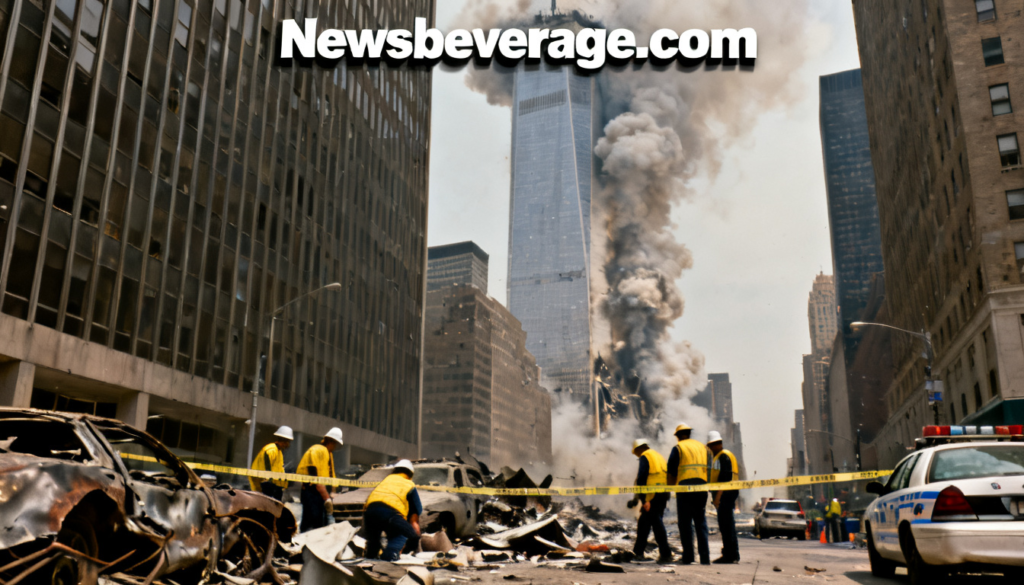
More than 400 firefighters and 200 police officers responded to the scene. The full evacuation took several hours. Six people died — all from smoke inhalation or direct blast injuries. Over 1,000 people sought medical treatment.

The Victims
The six people killed in the attack were:
- Monica Smith — a 35-year-old secretary who was seven months pregnant
- Robert Kirkpatrick — a 61-year-old maintenance supervisor
- Stephen Knapp — a 47-year-old maintenance worker
- Bill Macko — a 57-year-old maintenance worker
- Wilfredo Mercado — a 37-year-old restaurant worker
- John DiGiovanni — a 45-year-old dental salesman
Their deaths were not sensationalized. They were ordinary people doing ordinary things on an ordinary workday. That is exactly what makes this attack so deeply troubling.
The Investigation and Arrests
The Rental Van Blunder
The investigation broke open quickly — and it broke open because of a stunning mistake by one of the bombers.
Mohammed Salameh returned to the Ryder rental agency to claim his $400 deposit, saying the van had been stolen. FBI agents were already tracing the vehicle identification number found in the wreckage. They let Salameh return several more times before arresting him on March 4, 1993 — just six days after the bombing.
Following the Evidence
From Salameh, agents unraveled the larger conspiracy. They traced phone calls, financial transactions, and travel records. They found bomb-making manuals and chemicals in apartments linked to the suspects.
Nidal Ayyad was arrested on March 10, 1993. Mahmud Abouhalima was arrested in Egypt and extradited. Ahmad Ajaj was already in federal custody when the bombing occurred — he had been detained at JFK Airport months earlier.
The Trial and Convictions
In 1994, four men stood trial: Mohammed Salameh, Nidal Ayyad, Mahmud Abouhalima, and Ahmad Ajaj. All four were convicted on all counts and sentenced to 240 years in prison each.
Ramzi Yousef was tried separately in 1997 and convicted. He received two life sentences plus 240 years.
Eyad Ismoil was captured in Jordan in 1995 and convicted in 1997.
Omar Abdel Rahman was convicted in 1995 of seditious conspiracy in a separate but related trial.
The prosecutions were considered a significant success for federal law enforcement.
Why Did This Attack Happen?
Understanding the motivation behind the 1993 World Trade Center bombing helps explain why it happened — and why similar attacks kept coming.
The bombers were motivated by:
- Anti-American foreign policy sentiment, particularly U.S. support for Israel and American military presence in Muslim-majority countries
- Religious extremist ideology promoted by figures like Omar Abdel Rahman
- Connection to early al-Qaeda networks forming under Osama bin Laden in Afghanistan and Pakistan
Ramzi Yousef wanted to cause mass civilian casualties as a political statement. He viewed the World Trade Center as a symbol of American economic and political power. He wanted to destroy it.
This attack was not random. It was ideological, planned, and targeted. That pattern would repeat itself on a far more devastating scale eight years later.
What Changed After the 1993 Bombing?
Immediate Security Upgrades
The attack revealed serious gaps in the security of major public buildings. In response, the World Trade Center management:
- Closed public access to the parking garage
- Installed security checkpoints at vehicle entry points
- Upgraded the emergency generator and lighting systems
- Improved evacuation protocols for high-rise buildings
Impact on U.S. Counterterrorism Policy
The 1993 bombing was a pivotal moment for American intelligence and law enforcement. For the first time, agencies had to confront the reality of domestic terrorism carried out by foreign extremists.
Some changes that followed included:
- Increased FBI focus on international terrorist networks operating inside the United States
- Expanded cooperation between the FBI and CIA
- Greater attention to visa and immigration screening
- The establishment of the Joint Terrorism Task Force as a more active institution
However, many analysts argue that the United States did not go far enough. The intelligence community still operated with significant blind spots. Agencies did not fully share information. The threat was treated more as a law enforcement problem than a national security crisis.
That mindset would prove costly in the years ahead.
The Road to 9/11
The 1993 World Trade Center bombing sits at the beginning of a thread that leads directly to September 11, 2001. Ramzi Yousef’s uncle was Khalid Sheikh Mohammed — the man who later masterminded the 9/11 attacks. Al-Qaeda studied the 1993 attack and learned from it.
The 9/11 Commission Report explicitly noted that the United States failed to connect the dots between the 1993 bombing and the growing threat of al-Qaeda. The country had eight years to act more decisively. It did not.
The Legacy of February 26, 1993
The 1993 World Trade Center bombing is sometimes overshadowed by the catastrophic events of September 11. But it deserves its own recognition and study.
It was the first major act of international terrorism on American soil. It killed six people and wounded more than a thousand. It revealed that powerful enemies existed who had both the will and the capability to strike at the heart of American society.
The attack also proved something important about American institutions: they worked. The investigation was thorough and fast. The prosecutions were successful. The judicial system functioned. Six men went to prison for life.
But the deeper lesson — the one about vigilance, intelligence sharing, and taking threats seriously before they escalate — took far too long to learn.
Conclusion
The 1993 World Trade Center bombing was not just a historical footnote. It was a turning point. It showed the world that America was not untouchable. It introduced Americans to a new kind of threat: organized, ideologically motivated, international terrorism.
You now understand who planned the attack, how it was carried out, who died, how the investigation unfolded, and what changed because of it. You also understand how it connects to the far larger tragedy that followed in 2001.
History does not repeat itself exactly. But it rhymes. The lessons of February 26, 1993, matter today as much as they did then.
What do you think America learned from the 1993 bombing? And what lessons do you think still go unheeded? Share your thoughts in the comments below.
Frequently Asked Questions (FAQs)
1. What was the date of the 1993 World Trade Center bombing? The bombing occurred on February 26, 1993, at 12:17 PM local time in New York City.
2. How many people died in the 1993 World Trade Center bombing? Six people were killed in the attack. Over 1,000 others were injured, many from smoke inhalation during the chaotic evacuation.
3. Who was responsible for the 1993 World Trade Center bombing? Ramzi Yousef led the attack. He was supported by a group including Mohammed Salameh, Nidal Ayyad, Mahmud Abouhalima, Ahmad Ajaj, and Eyad Ismoil. Omar Abdel Rahman was convicted in connection with a broader conspiracy.
4. What kind of bomb was used in the 1993 World Trade Center bombing? The attackers used a urea nitrate truck bomb weighing approximately 1,336 pounds. It also contained nitroglycerin and hydrogen gas canisters intended to increase the blast radius.
5. Was the 1993 bombing connected to al-Qaeda? Yes. Ramzi Yousef had ties to the early al-Qaeda network. His uncle, Khalid Sheikh Mohammed, later planned the September 11 attacks. The bombing is widely seen as an early al-Qaeda-linked operation on American soil.
6. Were the bombers caught and convicted? Yes. All major conspirators were arrested within months and convicted. Most received sentences of 240 years or more. Ramzi Yousef was convicted in 1997 and is serving two life sentences.
7. What was the intended goal of the attack? Ramzi Yousef intended to topple the North Tower into the South Tower, killing an estimated 250,000 people. The towers’ structural integrity prevented this outcome.
8. How did the investigation break open so quickly? Mohammed Salameh attempted to reclaim the rental deposit for the van used to carry the bomb. FBI agents traced the vehicle identification number from the wreckage to the rental and arrested Salameh when he returned to the agency.
9. How did the 1993 bombing affect U.S. security policy? It led to increased FBI attention on domestic terrorism, improvements to building security protocols, and expanded counterterrorism cooperation between agencies. However, many critics argue the changes were insufficient given what followed in 2001.
10. How is the 1993 bombing connected to the September 11 attacks? The 9/11 attackers studied the 1993 bombing. Ramzi Yousef’s uncle masterminded 9/11. The failure to fully act on the lessons of 1993 is considered a contributing factor to the intelligence and security failures that preceded September 11, 2001.
About the Author
James Whitfield is a security and modern history writer with over a decade of experience covering terrorism, geopolitics, and American national security policy. He has contributed to several online publications focused on historical analysis and contemporary security issues. James holds a degree in Political Science with a concentration in International Relations. He believes that understanding history clearly is the first step toward preventing its worst chapters from repeating.
Also read Newsbeverage.com
Email: johanharwen314@gmail.com
Author Name: Johan Harwen